
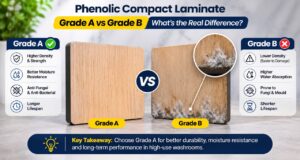
When choosing a toilet cubicle system, appearance is often the first thing people notice. However, two panels that look almost identical can perform very differently over time.
Phenolic compact laminate is widely used in commercial and public washrooms because of its durability, moisture resistance and suitability for demanding environments. However, not all compact laminate panels are manufactured to the same quality or performance specifications.
So, what is the real difference between Grade A and Grade B phenolic compact laminate, and why should contractors, architects and building owners pay attention?
1. What Is Phenolic Compact Laminate?
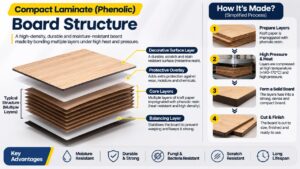
Phenolic compact laminate is a high-density material manufactured using multiple layers of resin-impregnated kraft paper, compressed under high pressure and temperature.
This manufacturing process creates a rigid, durable panel suitable for various commercial applications, including:
Toilet cubicle systems
Shower partitions
Changing rooms
Locker systems
Commercial washrooms
Educational and healthcare facilities
Its performance makes it a popular material choice for environments where moisture, frequent cleaning and heavy daily usage are common.
2. What Is the Difference Between Grade A and Grade B Phenolic Compact Laminate?
Although both materials may have a similar appearance, differences in raw materials, resin content, manufacturing processes and quality control can affect their overall performance.
The terms Grade A and Grade B are commonly used as commercial quality descriptions by suppliers. However, they are not universal technical classifications. Actual material quality should always be evaluated through product specifications, test reports and physical samples.
Comparison | Higher-quality laminate (Grade A) | Lower-quality laminate (Grade B) |
|---|---|---|
Raw material | More consistent material quality | Quality may vary |
Panel density | Generally more consistent | May be less consistent |
Moisture resistance | Typically better | May be more vulnerable |
Dimensional stability | Generally more stable | Greater potential for deformation |
Surface durability | Typically more durable | May deteriorate sooner |
Quality control | More consistent | Depends on manufacturer |
Initial cost | Generally higher | Generally lower |
Long-term value | Potentially better | May involve additional maintenance costs |
3. Moisture Resistance: Why It Matters in Toilet Cubicle Systems
Commercial washrooms are constantly exposed to moisture, humidity, water splashes and cleaning activities.
In Malaysia, where the climate is naturally hot and humid, selecting a suitable moisture-resistant material is particularly important.
Poor-quality or unsuitable panels may experience problems such as edge deterioration, surface damage, swelling, deformation or reduced structural stability.
A high-quality phenolic compact laminate panel is designed to withstand demanding washroom conditions while maintaining its appearance and functionality when properly installed and maintained.
The important question is not simply whether a panel can resist water today, but how consistently it can perform over years of daily exposure.
4. D’Cubicle Material Water Test : What Did We Discover?
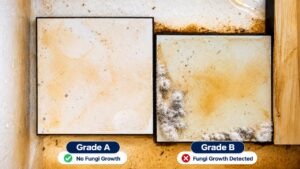
What does this experiment tell us?
The experiment demonstrated that materials with a similar appearance may respond differently when exposed to the same environmental conditions.
While this internal observation is not a certified laboratory test and does not establish the performance of every Grade A or Grade B product, it highlights the importance of evaluating material quality before making a purchasing decision.
For contractors and project owners, reviewing physical samples and verified technical specifications can help reduce the risk of selecting unsuitable materials.
Similar appearance does not always mean similar performance.
5. Is Cheaper Phenolic Compact Laminate Really More Cost-Effective?
When managing a construction or renovation project, budget is always an important consideration. However, selecting a toilet cubicle system based solely on the lowest quotation may result in additional expenses in the future.
These expenses may include panel replacement, frequent repairs, additional maintenance, labour costs and washroom downtime. A higher-quality material may require a greater initial investment, but its potential for longer service life and reduced maintenance can provide better overall value.
For commercial projects, the best investment is not necessarily the cheapest option, but the system that delivers reliable performance throughout its intended service life.
6. Which Projects Benefit from High-Quality Phenolic Compact Laminate?
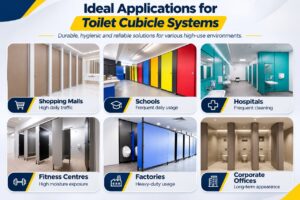
These environments require toilet cubicle systems that can withstand frequent usage, cleaning activities and varying levels of moisture exposure without compromising functionality. Material selection should always reflect the actual requirements of the project.
7. How to Identify a High-Quality Phenolic Compact Laminate Panel
Before approving a toilet cubicle material, contractors, architects and project owners should consider the following:
What to check | Why it matters |
|---|---|
Material specifications | Understand the actual product composition and performance |
Panel thickness | Ensure suitability for the system design |
Core and edge quality | Check material consistency and finishing |
Moisture resistance | Evaluate suitability for wet environments |
Surface finishing | Assess appearance and durability |
Technical test reports | Verify manufacturer performance claims, such as applicable EN 438 test results |
Product warranty | Understand coverage and limitations |
Physical material samples | Evaluate the product before approval |
Supplier expertise | Ensure proper technical guidance and installation support |
Notes : Never rely solely on colour, appearance, price or a supplier’s grade description when evaluating a toilet cubicle panel.
8. Why Choose D’Cubicle Advanced Sdn Bhd?
At D’Cubicle Advanced Sdn Bhd, we believe that a reliable toilet cubicle system begins with informed material selection.
Our approach goes beyond supplying toilet partitions. We help clients understand the materials, accessories and system configurations suitable for their project requirements. Our services include :-
Professional toilet cubicle consultation
Material and colour selection
Physical material samples
Free physical mockup programme
Customised toilet cubicle solutions
Fabrication and installation
Project coordination and technical support
Whether you are planning a new commercial development, upgrading an existing washroom or managing a large-scale construction project, selecting the right material is an important step towards achieving reliable long-term performance.
Frequently Asked Questions (FAQs)
1. Is Grade A phenolic compact laminate waterproof?
High-quality phenolic compact laminate generally offers excellent moisture resistance. However, its suitability for prolonged water exposure should be verified against the manufacturer’s technical specifications.
2. Is Grade B phenolic compact laminate suitable for toilet cubicles?
Suitability depends on the actual material specifications, verified performance and project environment. A grade label alone is insufficient to determine suitability.
3. Can phenolic compact laminate develop mould?
Fungal growth can occur on contaminated surfaces under favourable moisture conditions. Material quality, environmental conditions and cleaning practices can all influence the outcome.
4. What is the best thickness for phenolic toilet cubicle panels?
Common panel thicknesses include 10mm, 12mm and 18mm. The appropriate thickness depends on the cubicle design, hardware, structural requirements and intended application.
5. Can I request a phenolic compact laminate sample before purchasing?
Yes. D’Cubicle provides material samples and physical mockup options to help clients evaluate suitable materials before making a project decision.
Conclusion: Quality Is More Than What You See
Choosing the right phenolic compact laminate is not just about colour, thickness or price. It is about selecting a material that can perform reliably under real-world conditions.
Understanding the differences between material quality levels helps contractors, architects and building owners make better decisions, reduce potential maintenance issues and protect their long-term investment.
At D’Cubicle, we believe that every successful washroom project starts with the right material, the right system and the right expertise.
Because quality should not only look good today — it should perform for years to come.
Planning Your Next Toilet Cubicle Project?
Contact D’Cubicle Advanced Sdn Bhd today to request a free material sample, discuss your project requirements or arrange a physical mockup.
D’Cubicle — Every Toilet Has A Story.1. What Is Phenolic Compact Laminate?